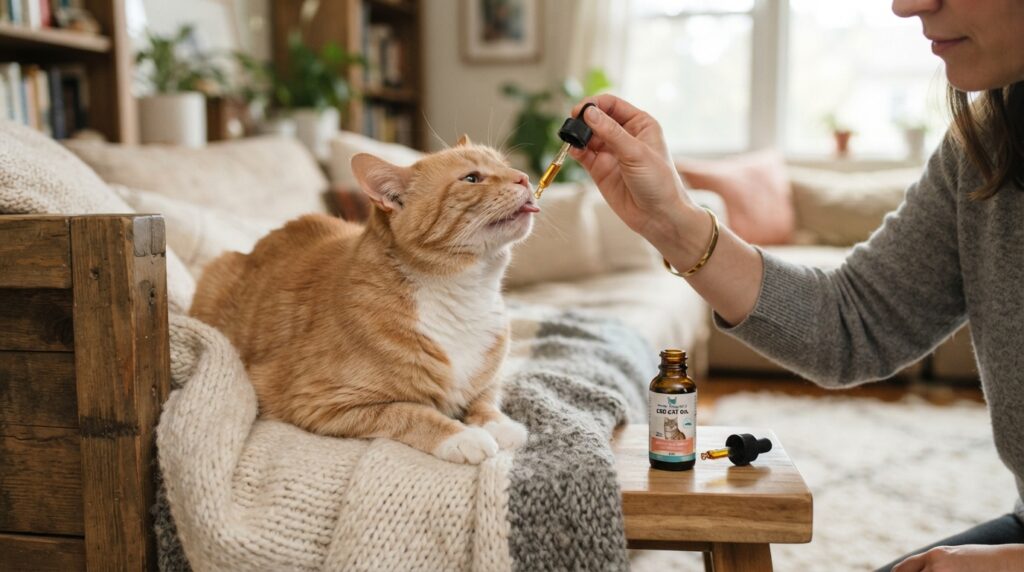
Medicine cabinets rarely come with a manual for cats. A dropper, a tiny body, and a label full of numbers can turn a simple task into a math problem at seven in the morning.
That is where most confusion about CBD oil for cats begins. The product itself is straightforward, yet the arithmetic behind the amount is where owners trip. Mistakes usually come from mixing up milligrams, milliliters, and drops, three units that sound alike and mean very different things.
This guide walks through the measuring side. The amount a cat should receive comes from a veterinarian, since no official dose exists for cats, and the goal here is to make that instruction easy to follow accurately.
Understand the Numbers on the Label
Milligrams Versus Milliliters
Milligrams (mg) measure how much CBD is present. Milliliters (mL) measure how much liquid there is. A label that says 300 mg on a 30 mL bottle holds 10 mg of CBD in every milliliter, and that second figure, called concentration, is the number that drives every calculation.
Problems start when a label lists only the total milligrams. Without the bottle size, the concentration is hidden. A shopper who cannot find both numbers on the box or the product page should ask the seller before buying, because guessing leads to errors in either direction.
Why Drops Are Unreliable
Many labels describe amounts in drops, and the convention is shaky. A milliliter is often cited as roughly 20 drops, yet the real number depends on the dropper tip, the thickness of the oil, the angle of the bottle, and even room temperature. Oils with a heavier carrier fall more slowly and form larger drops.
For a human adult, that variation barely matters. For a cat weighing eight pounds, a few extra drops can represent a sizeable jump in the amount received, which is why milliliters measured with a syringe are the steadier method.
Cat Size Changes Everything
The average adult domestic cat weighs somewhere between eight and ten pounds, though a petite female may sit near six and a large Maine Coon male can pass fifteen. Veterinary medicine usually scales amounts to body weight, often expressed in milligrams per kilogram, and that logic is why a bottle meant for a 60-pound dog is a poor guide for a cat.
No weight-based CBD chart has been validated for cats. Any website offering a calculator that spits out a confident number is inventing precision that the research does not support. A recent weigh-in at the clinic gives the vet the figure that matters.
Converting a Vet’s Instruction
Vets may give instructions in milligrams or in milliliters. When the instruction is in milligrams, divide that number by the concentration to find the volume. If a vet recommends x milligrams and the bottle holds 10 mg per mL, the volume is x divided by 10 mL. The symbols are used on purpose, since the right amount for a given cat is the vet’s call.
Ask the clinic to write the answer in milliliters for the specific bottle in hand. A product change, even within the same brand, can alter the concentration and make an old instruction wrong overnight.
Tools That Make Measuring Easier
The Oral Syringe
A 1 mL oral syringe has fine markings, often in hundredths of a milliliter, and lets owners measure small volumes with far less guesswork than a dropper. Pharmacies sell them cheaply, and many vet clinics hand them out when they approve a supplement.
Draw up the oil slowly to avoid air bubbles, wipe the tip, and keep the syringe for one product only. Rinse with warm water and let it dry between uses, since stale oil turns rancid and can sour a cat’s appetite.
Droppers and Their Limits
Bottle droppers are fine for rough amounts but poor for small, precise ones. Glass droppers filled to a line on the pipette vary with how far the bulb is squeezed. Some bottles carry marks at 0.25 mL, 0.5 mL, and 1 mL, which helps only when the intended amount is close to one of those lines.
A reasonable workaround is to measure into a clean spoon or small dish with a syringe first, then offer it. That adds a step but prevents the slow creep of larger and larger squeezes.
Quick Comparison of Tools
| Tool | Accuracy | Best for | Drawback |
|---|---|---|---|
| 1 mL oral syringe | High | Small, exact amounts | Needs cleaning each time |
| Marked dropper | Moderate | Amounts near the printed lines | Squeeze pressure varies |
| Counting drops | Low | Rough reference only | Drop size changes |
| Pre-dosed treat | Depends on maker | Cats that refuse oils | Hard to adjust |
A syringe wins on accuracy, and nothing else comes close.
Labeling the Bottle
Write the vet’s instruction on a sticky note and attach it to the box. Include the date, the concentration, and the amount in milliliters. A note taped to the cabinet door also helps when another family member or a pet sitter takes over.
Write the opening date on the bottle too. Opened oils age, and many are best used within a few months of opening unless the label says otherwise.
Build a Routine That Sticks
Timing Around Meals
Many owners offer the oil with a small portion of wet food, since a routine tied to mealtime is easier to remember. A cat with a sensitive stomach may do better after eating, while one that gobbles breakfast may accept the oil first.
The vet can guide timing, and consistency matters more than the exact hour. Cats thrive on predictability, and a steady schedule makes any change in behavior easier to spot.
Adjusting Gradually
If the vet recommends increasing the amount, one change at a time is the rule. Wait several days between steps so that any reaction is clearly linked to the change. Adjusting two things at once, such as the amount and the brand, makes the results impossible to read.
Never adjust because the cat seems unchanged after a day or two. Effects, if any, are poorly understood in cats, and impatience is a common route to overdoing it.
Logging Each Dose
A one-line entry per dose keeps the record honest:
- Date and time
- Product and batch number
- Amount in milliliters
- Appetite and energy afterward
- Litter box notes
- Anything unusual, such as drooling or hiding
Patterns show up quickly in a log, and the vet will find it more useful than any summary from memory.
Mistakes That Come Up Often
The usual slip-ups are using a dog product, reading total milligrams as per-milliliter strength, counting drops, and switching brands without recalculating. A fifth is giving extra to make up for a missed day, which is an easy way to overshoot.
Owners who catch these early tend to settle into a calm routine. Those who do not often end up with a log full of puzzling days.
After a Missed Dose
Skip it and return to the usual schedule. Doubling up to compensate raises the amount at one time and has no known upside for cats. If a vet gave different advice for a specific situation, follow that instead.
A reminder alarm on a phone, placed beside the cat’s feeding time, prevents most missed doses.
Final Thoughts
Easy dosing comes down to knowing the concentration, measuring in milliliters, and following a vet’s written instruction. A 1 mL oral syringe beats counting drops every time. A log of each dose turns vague impressions into usable records. When anything changes, whether the product, the batch, or the cat’s behavior, the math and the vet should be consulted again.